Posts in Category: Surfaces
Finzel Swamp
 This is a TNC (The Nature Conservancy) preserve on Savage Mountain in the Maryland Highlands. From the TNC website:
A window into ice ages past, Finzel Swamp is located in a “frost pocket,” an area where the surrounding hills capture moisture and cold air that conspire to create a landscape more reminiscent of habitat found much further north in Canada…. In addition to the shrub swamp, the preserve contains three other distinct plant communities, and is the headwaters to the Savage River. The mountain peatlands created by this rare mix of altitude, temperature, and precipitation are home to a spectacular range of plants, birds, and mammals.
Finzel is about 2600 feet above sea level. It is the headwaters of the Savage River. For comparison, Cranberry Glades in the Cranberry Wilderness of the West Virginia Highlands is a much larger frost pocket. Cranberry is about 3600 feet above sea level and is the headwaters of the Cranberry River.
28-90mm Leica Vario-Elmarit, Nikon 800e, Lr4, Ps CS6.
Sublime Light

Schoolhouse Ridge South, Harpers Ferry National Historical Park this past Saturday morning. For Aleksa.
75mm Pentax-A 645, Nikon 800e, Lr5, Ps CS6.
Lone Star
 One of my favorite early morning places: Schoolhouse Ridge South, Harpers Ferry National Historical Park before sunrise.
75mm Pentax-A 645, Nikon 800e, Lr5, Ps CS6.
More A-Lens at the Crossroads
 Hackberries and ailanthus withstand being nuked every spring by the chemical onslaught of modern farming practices. They’re tough trees… oaks, hickories, and people don’t fare as well. Last spring, for whatever reason, they plowed instead of spraying! I continue to hope that it was not a fluke but is a long term change in practices. I owe someone a big thank you if it proves to be a change. How long I live might depend on it being a change.
Hackberry, Celtis occidentalis; ailanthus, Ailanthus altissima (highly invasive nonnative); Homo sapiens (a self endangered species, apparently bent on self destruction).
35mm Sigma-A, Nikon 800e, Lr4, Ps CS6.
About at the Crossroads
 I was out and about last evening, checking out a new lens. For the photographers who might stumble onto this, it is the Sigma 35mm f1.4 A. It really is as good as the hype! I will be watching with interest to see what other A lenses they bring to market.
35mm Sigma A, Nikon 800e, Lr5, Ps CS6.
Canaan Valley Haws

Lots of old gnarly hawthorns in Canaan Valley, Crataegus sp, though this group is relatively young.
This image was processed from raw in Aperture. I use Lightroom now for conversions because because I like some of the tools better. But having said that the color renderings I get from Aperture are far superior to Lightroom, IMHO of course. Wish I could take some tools from Lightroom and Capture 1 and and use them with Aperture’s color engine.
150mm Pentax 645-A, Canon 5D Mk II, Aperture 3.x, Ps CS6.
Shays Run: Elakala Falls No. One
 A detail of the falls. There is more off to the right. With Robert H Clark.
28-90mm Leica Vario-Elmarit ASPH, Nikon 800e, Lr5, Ps CS6.
Dawn on Canaan Mountain Bog
 A favorite place, especially at dawn and dusk. Cabin Mountain is just visible in the distance, lower right. The white stuff out there, for those not familiar with such places, is a sedge called cotton grass – an Eriophorum species.
This exposure was made in September of 2012 on a trip with photo-buddy Robert Clark. From here we went to Blackwater Falls to photograph Shays Run (next image) where we got soaked in a heavy rain.
28-90mm Leica Vario-Elmarit ASPH, Nikon 800e, Lr5, Ps CS6.
Clifton Forge
 The location of the mothballed Greenbriar Presidential Express and railroad hub of southeastern West Virginia.
80mm f2.8 Zeiss Planar F (Hasselblad), Mirex Tilt/Shift Adapter, Nikon 800e, Lr5, PS CS6.
The Greenbrier Presidential Express
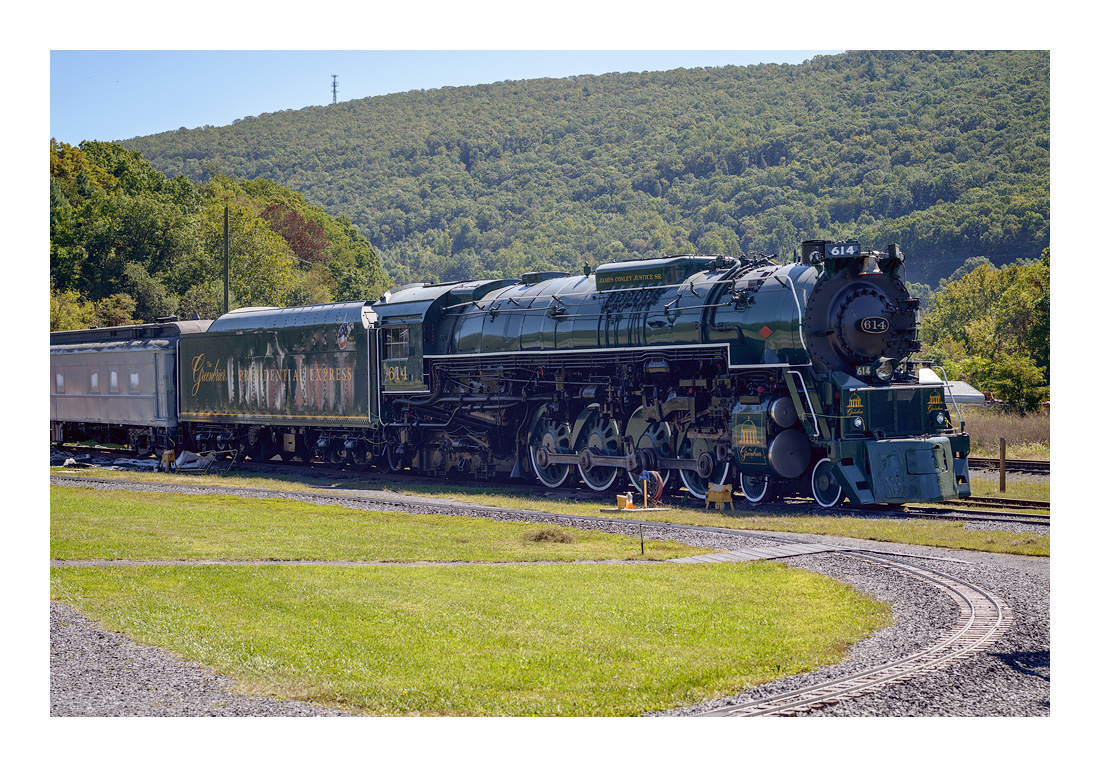 When I was young and had a fascination with railroads, this coal fired steam engine and others like it were the primary power source. Frankly from the perspective of living in today’s electronics world, I am simply awestruck by the mechanical workings of these behemoths and what it must have taken to keep them in good running condition. This engine has a lot of missing parts including the main driving “rod”, but if you look you can see where it connected to the second drive wheel. The mechanical advantage with the connecting pin so close to the center of the wheel is so small that the power generated by the piston that pushed that rod must have been enormous. They say nobody knew how fast these steam engines could go because nobody was crazy enough to really find out… and there wasn’t enough straight track!
It must have taken considerable effort to keep these babies in good working order, all those moving parts to keep inspected and lubricated, steam lines, water lines, condensers, sand for traction (the drivers would spin on the track), a boiler, the firebox. I bet it was hot as can be in the cab too… miserable in the summer, especially standing still.
I remember standing on a bridge in East Liberty with my father watching inbound trains where I think they went underground. This was in the early 1950s, less than ten years after the war ended. Pittsburgh was still an industrial powerhouse. The trains and the rivers moved most of the raw materials and the product to their finishing locations. There were not nearly so many trucks in use then and no interstate highways. Most highways were two or occasionally three lane (the middle lane was for passing from either direction!) meandering roads that went through each little town or city along the route. It took forever to get anywhere.
80mm f2.8 Zeiss Planar F (Hasselblad), Mirex Tilt/Shift Adapter, Nikon 800e, Lr5, PS CS6.