Posts Tagged: steam power
The Greenbrier Presidential Express
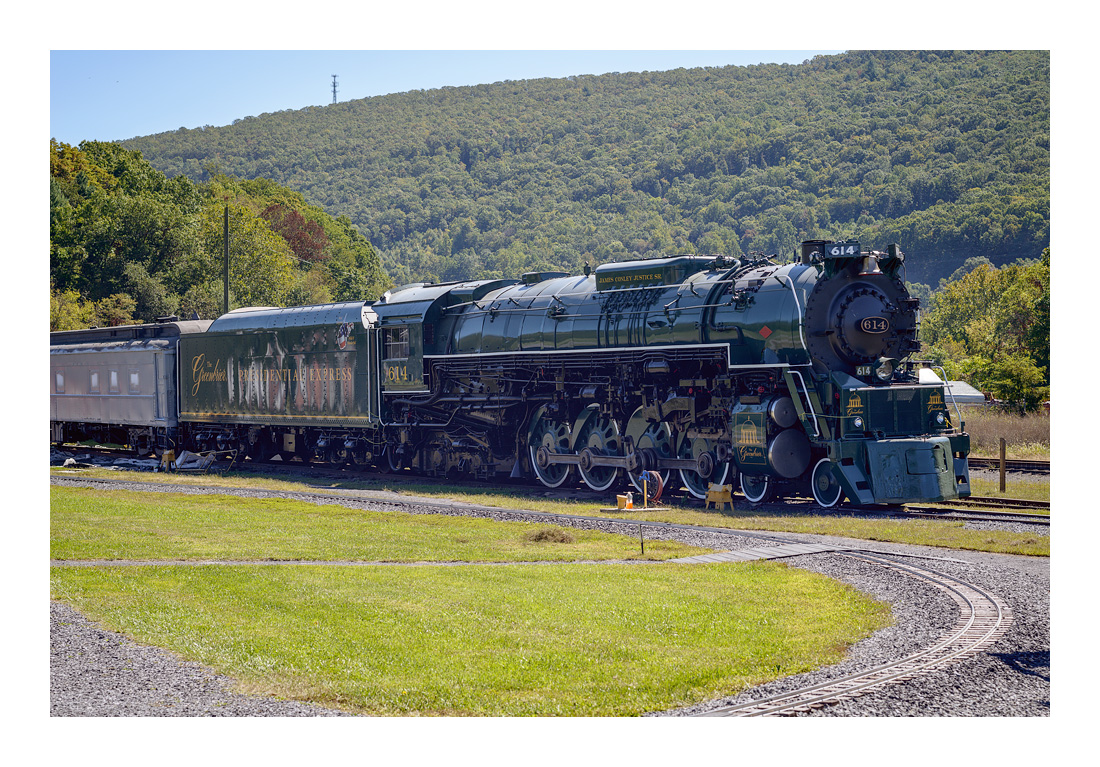 When I was young and had a fascination with railroads, this coal fired steam engine and others like it were the primary power source. Frankly from the perspective of living in today’s electronics world, I am simply awestruck by the mechanical workings of these behemoths and what it must have taken to keep them in good running condition. This engine has a lot of missing parts including the main driving “rod”, but if you look you can see where it connected to the second drive wheel. The mechanical advantage with the connecting pin so close to the center of the wheel is so small that the power generated by the piston that pushed that rod must have been enormous. They say nobody knew how fast these steam engines could go because nobody was crazy enough to really find out… and there wasn’t enough straight track!
It must have taken considerable effort to keep these babies in good working order, all those moving parts to keep inspected and lubricated, steam lines, water lines, condensers, sand for traction (the drivers would spin on the track), a boiler, the firebox. I bet it was hot as can be in the cab too… miserable in the summer, especially standing still.
I remember standing on a bridge in East Liberty with my father watching inbound trains where I think they went underground. This was in the early 1950s, less than ten years after the war ended. Pittsburgh was still an industrial powerhouse. The trains and the rivers moved most of the raw materials and the product to their finishing locations. There were not nearly so many trucks in use then and no interstate highways. Most highways were two or occasionally three lane (the middle lane was for passing from either direction!) meandering roads that went through each little town or city along the route. It took forever to get anywhere.
80mm f2.8 Zeiss Planar F (Hasselblad), Mirex Tilt/Shift Adapter, Nikon 800e, Lr5, PS CS6.